Papers, preprints & research resources
Publications
Scalable graph learning, AI for system design, cybersecurity, and document intelligence.
Browse papers and preprints below, with summaries, figures, and research resources. Preprints and accepted papers are labeled by status.
2026
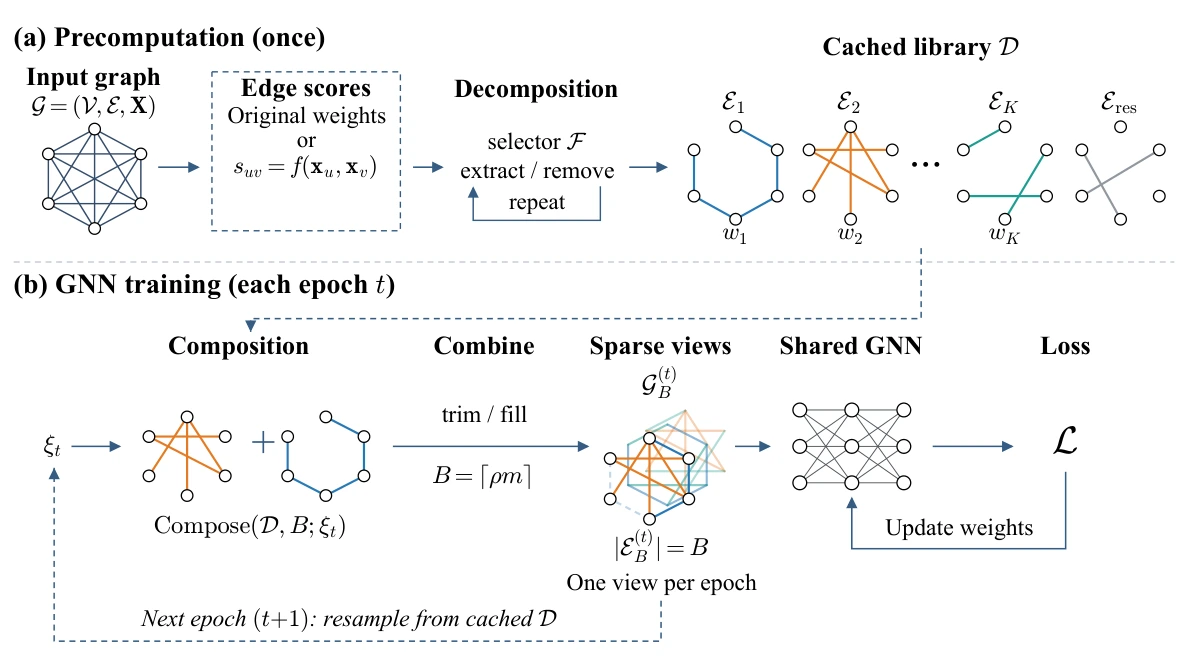
EDiS: Edge Disjoint Subgraph Sparsification Framework for Graph Neural Networks
arXiv:2610.09059 · 2026
Decompose a graph once, then reuse cached edge-disjoint subgraphs to compose a different sparse training graph each epoch. EDiS separates structural extraction from epoch-level sampling and evaluates this approach across 19 node classification benchmarks.
BibTeX citation
@misc{das_edis_2026,
  title = {EDiS: Edge Disjoint Subgraph Sparsification Framework for Graph Neural Networks},
  author = {Sai Karthik Navuluru and Siddhartha Shankar Das and Franck Dernoncourt and S M Ferdous and Ryan A. Rossi and Nesreen K. Ahmed and Baris Coskunuzer and Alex Pothen and Lakshman Tamil and Mahantesh M Halappanavar},
  year = {2026},
  eprint = {2610.09059},
  archivePrefix = {arXiv},
  url = {https://arxiv.org/abs/2610.09059}
}
Scaffold: Support Graph Theory Based Sparsification for Graph Neural Networks
arXiv:2609.31466 · 2026
An unsupervised sparsification framework that controls the length of rerouted communication paths and the load they place on retained edges. Across 19 benchmarks, sparse supports retain 10–50% of edges while recovering or closely approaching full-graph GNN performance.
BibTeX citation
@misc{das_scaffold_2026,
  title = {Scaffold: Support Graph Theory Based Sparsification for Graph Neural Networks},
  author = {Siddhartha Shankar Das and Sai Karthik Navuluru and S M Ferdous and Ryan A. Rossi and Baris Coskunuzer and Lakshman Tamil and Edoardo Serra and Alex Pothen and Robert Rallo and Mahantesh M Halappanavar},
  year = {2026},
  eprint = {2609.31466},
  archivePrefix = {arXiv},
  url = {https://arxiv.org/abs/2609.31466}
}Diff-GNN: Differentiable Graph Neural Networks for Joint Hardware–Software Partitioning and Scheduling
IEEE High Performance Extreme Computing Conference (HPEC) · 2026
Differentiable graph learning for jointly assigning computation to hardware or software and scheduling its execution. This work connects learned graph representations with system design and optimization under resource and communication constraints.
Accepted at HPEC 2026; listed in the September 17 conference program. Public paper and code links will be added when available.
BibTeX citation
@inproceedings{das_diff_gnn_2026,
  title = {Diff-GNN: Differentiable Graph Neural Networks for Joint Hardware–Software Partitioning and Scheduling},
  author = {Siddhartha Shankar Das and Zakaria Mehrab and James Kotary and Rounak Meyur and S. M. Ferdous and Erdal Mutlu and Mahantesh Halappanavar},
  year = {2026},
  booktitle = {IEEE High Performance Extreme Computing Conference (HPEC)},
  url = {https://ieee-hpec.org/ieee-hpec-2026-agenda/}
}Joint Optimization of HW/SW Partitioning and Scheduling with Deep Reinforcement Learning
IEEE High Performance Extreme Computing Conference (HPEC) · 2026
Reinforcement learning for the coupled decisions of hardware/software partitioning and task scheduling. The conference program lists this work as “Joint Optimization of HW/SW Partitioning and Scheduling with Policy Gradient Methods.”
Title follows the October 2026 CV; the official program uses the policy-gradient title. Accepted status follows the CV.
BibTeX citation
@inproceedings{das_hw_sw_rl_2026,
  title = {Joint Optimization of HW/SW Partitioning and Scheduling with Deep Reinforcement Learning},
  author = {James Kotary and Zakaria Mehrab and Siddhartha Shankar Das and Rounak Meyur and S. M. Ferdous and Erdal Mutlu and Mahantesh Halappanavar},
  year = {2026},
  booktitle = {IEEE High Performance Extreme Computing Conference (HPEC)},
  url = {https://ieee-hpec.org/ieee-hpec-2026-agenda/}
}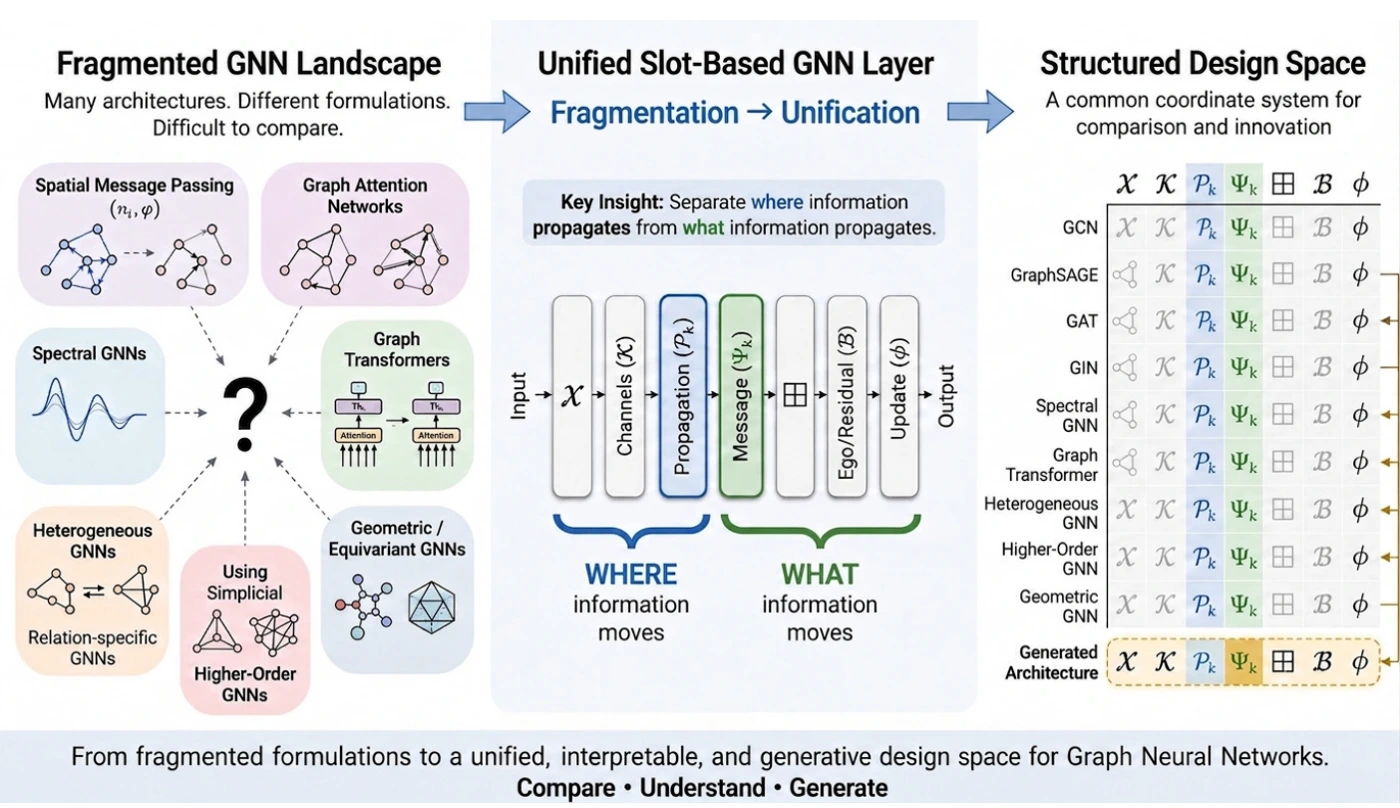
Unifying Graph Neural Networks Through a Common Layer Equation
arXiv:2608.16097 · 2026
A common layer equation organizes more than 200 GNN architectures into seven components. Separating propagation from message transformation makes architectural similarities explicit and supports component-level comparison, theoretical analysis, and architecture generation.
BibTeX citation
@misc{das_unifying_2026,
  title = {Unifying Graph Neural Networks Through a Common Layer Equation},
  author = {Sai Karthik Navuluru and Siddhartha Shankar Das and Bo Ni and Hongjie Chen and Yu Wang and Baris Coskunuzer and Nesreen K. Ahmed and Franck Dernoncourt and Mahantesh Halappanavar and Tyler Derr and Ryan A. Rossi and Lakshman Tamil},
  year = {2026},
  eprint = {2608.16097},
  archivePrefix = {arXiv},
  url = {https://arxiv.org/abs/2608.16097}
}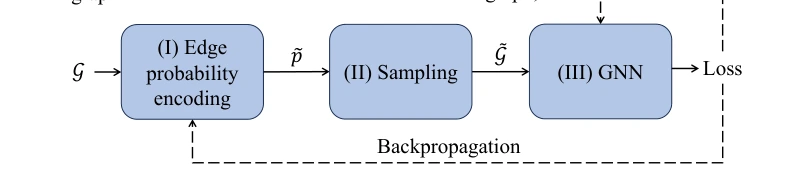
SGS-GNN: A Supervised Graph Sparsifier for Graph Neural Networks
Proceedings of the 32nd ACM SIGKDD Conference on Knowledge Discovery and Data Mining V.2, pp. 755–766 · 2026
Learn which graph edges matter for a downstream prediction task. SGS-GNN trains an edge probability model and a GNN together to sample compact, task-relevant subgraphs, reducing memory requirements while preserving predictive signal.
The 2025 arXiv version has an earlier title and six authors; the citation here follows the published KDD 2026 paper.
BibTeX citation
@inproceedings{das_sgs_gnn_2026,
  title = {SGS-GNN: A Supervised Graph Sparsifier for Graph Neural Networks},
  author = {Siddhartha Shankar Das and Naheed Anjum Arafat and Muftiqur Rahman and S M Ferdous and Alex Pothen and Mahantesh Halappanavar and Danda B. Rawat},
  year = {2026},
  booktitle = {Proceedings of the 32nd ACM SIGKDD Conference on Knowledge Discovery and Data Mining V.2, pp. 755–766},
  doi = {10.1145/3770855.3818110},
  eprint = {2502.10208},
  archivePrefix = {arXiv},
  url = {https://doi.org/10.1145/3770855.3818110}
}
2025
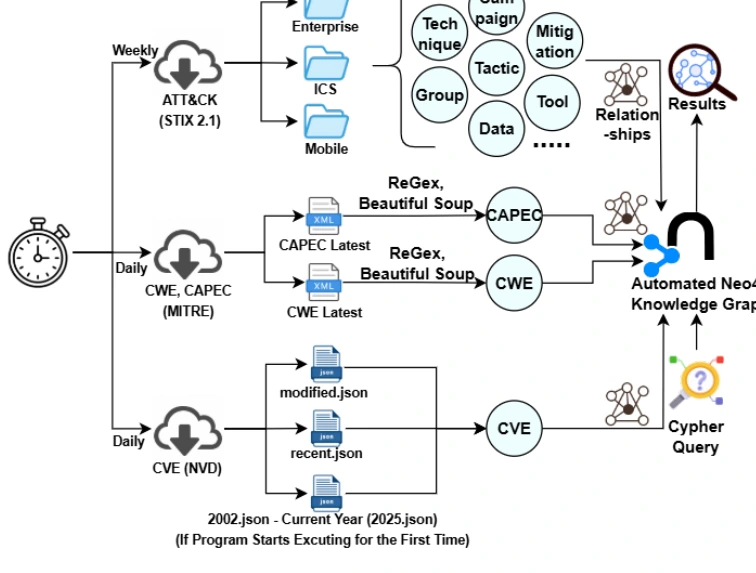
ATT&CK to CVE: A Large-Scale Automated Knowledge Graph for Threat Intelligence
IEEE International Conference on Data Mining Workshops (ICDMW), GTA³ Workshop · 2025
A continuously updated cybersecurity knowledge graph integrates CVE, CWE, CAPEC, and ATT&CK data in Neo4j. Automated ingestion and typed relationships support multi-hop threat analysis and connections between adversary behavior and software vulnerabilities.
BibTeX citation
@inproceedings{das_attack2cve_2025,
  title = {ATT\&CK to CVE: A Large-Scale Automated Knowledge Graph for Threat Intelligence},
  author = {Moqsadur Rahman and Monika Akbar and Joseph T. Aguayo and Mahmud Shahriar Hossain and Tina M. Ellis and Siddhartha Shankar Das and Mohammad Fakhruddin Babar and Monowar Hasan and Aaron Sanchez and Luis Fernando de la Torre and Mahantesh Halappanavar},
  year = {2025},
  booktitle = {IEEE International Conference on Data Mining Workshops (ICDMW), GTA³ Workshop},
  doi = {10.1109/ICDMW69685.2025.00140},
  url = {https://doi.org/10.1109/ICDMW69685.2025.00140}
}NEPATEC v2.0: Standardized Metadata and Text Corpus of National Environmental Policy Act Documents
Pacific Northwest National Laboratory, PNNL-38163 · 2025
A public corpus connects NEPA documents with standardized project, process, and document metadata. The report describes more than 120,000 documents from roughly 60,000 projects and over 60 agencies, enabling research in document intelligence and environmental permitting.
BibTeX citation
@techreport{das_nepatec_2025,
  title = {NEPATEC v2.0: Standardized Metadata and Text Corpus of National Environmental Policy Act Documents},
  author = {Sai Munikoti and Dan Nally and Sai Dileep Koneru and Siddhartha Shankar Das and Kaustav Bhattacharjee and Ashik Islam and Alex Buchko and Taylor Edwards and Kathy Nwe and Siddhisanket Raskar and Paul Rigor and Heng Wan and Micah Taylor and Scott Spare and Derek Lilienthal and Mahantesh Halappanavar and Anurag Acharya and Tim Vega and Mike Parker and Anastasia Bernat and Sameera Horawalavithana},
  year = {2025},
  institution = {Pacific Northwest National Laboratory, PNNL-38163},
  url = {https://www.pnnl.gov/publications/nepatec-v20-standardized-metadata-and-text-corpus-national-environmental-policy-act}
}Generative AI for Advanced Cyber Defense
AI for Cybersecurity: Research and Practice, John Wiley & Sons, pp. 109–146 · 2025
A book chapter on generative AI for cyber defense, connecting language models, security knowledge, and retrieval-based methods with practical cybersecurity applications.
BibTeX citation
@incollection{das_genai_cyber_2025,
  title = {Generative AI for Advanced Cyber Defense},
  author = {Moqsadur Rahman and Aaron Sanchez and Krish Piryani and Siddhartha Shankar Das and Sai Munikoti and Luis de la Torre Quintana and Monowar Hasan and Joseph Aguayo and Monika Akbar and Shahriar Hossain and Mahantesh Halappanavar},
  year = {2025},
  booktitle = {AI for Cybersecurity: Research and Practice, John Wiley \& Sons, pp. 109–146},
  doi = {10.1002/9781394293773.ch04},
  url = {https://doi.org/10.1002/9781394293773.ch04}
}Scaling Graph Neural Networks for Large Graphs and Analyzing Common Vulnerabilities via Large Language Models
Ph.D. dissertation, Purdue University. Advisor: Alex Pothen · 2025
Doctoral research on scalable GNN sampling and sparsification, together with language-model methods for vulnerability classification and analysis.
BibTeX citation
@phdthesis{das_dissertation_2025,
  title = {Scaling Graph Neural Networks for Large Graphs and Analyzing Common Vulnerabilities via Large Language Models},
  author = {Siddhartha Shankar Das},
  year = {2025},
  school = {Purdue University},
  url = {https://hammer.purdue.edu/articles/thesis/Scaling_Graph_Neural_Networks_for_Large_Graphs_and_Analyzing_Common_Vulnerabilities_via_Large_Language_Models/28856864}
}
2024
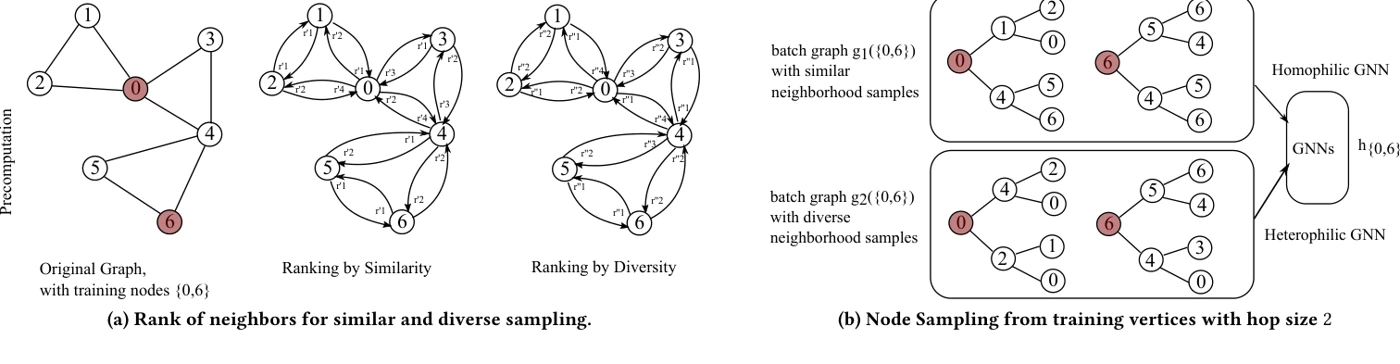
AGS-GNN: Attribute-guided Sampling for Graph Neural Networks
Proceedings of the 30th ACM SIGKDD Conference on Knowledge Discovery and Data Mining, pp. 538–549 · 2024
Attribute-guided sampling combines feature similarity and feature diversity to learn from both homophilic and heterophilic neighborhoods. Dual channels adapt to local graph structure, with evaluations on 35 small and large graphs.
BibTeX citation
@inproceedings{das_ags_gnn_2024,
  title = {AGS-GNN: Attribute-guided Sampling for Graph Neural Networks},
  author = {Siddhartha Shankar Das and S M Ferdous and Mahantesh M. Halappanavar and Edoardo Serra and Alex Pothen},
  year = {2024},
  booktitle = {Proceedings of the 30th ACM SIGKDD Conference on Knowledge Discovery and Data Mining, pp. 538–549},
  doi = {10.1145/3637528.3671940},
  eprint = {2405.15218},
  archivePrefix = {arXiv},
  url = {https://doi.org/10.1145/3637528.3671940}
}
2022
VWC-BERT: Scaling Vulnerability–Weakness–Exploit Mapping on Modern AI Accelerators
IEEE International Conference on Big Data, pp. 1224–1229 · 2022
Scalable language-model methods connect software vulnerabilities to weaknesses and exploits. VWC-BERT studies training and inference on modern AI accelerators to make vulnerability analysis practical at larger scales.
BibTeX citation
@inproceedings{das_vwc_bert_2022,
  title = {VWC-BERT: Scaling Vulnerability–Weakness–Exploit Mapping on Modern AI Accelerators},
  author = {Siddhartha Shankar Das and Mahantesh Halappanavar and Antonino Tumeo and Edoardo Serra and Alex Pothen and Ehab Al-Shaer},
  year = {2022},
  booktitle = {IEEE International Conference on Big Data, pp. 1224–1229},
  doi = {10.1109/BigData55660.2022.10020622},
  url = {https://doi.org/10.1109/BigData55660.2022.10020622}
}Towards Automatic Mapping of Vulnerabilities to Attack Patterns Using Large Language Models
IEEE International Symposium on Technologies for Homeland Security (HST), pp. 1–7 · 2022
VWC-MAP links vulnerability descriptions to attack patterns through a two-tier pipeline: vulnerability-to-weakness classification followed by weakness-to-attack mapping using text-to-text and link prediction methods.
BibTeX citation
@inproceedings{das_vwc_map_2022,
  title = {Towards Automatic Mapping of Vulnerabilities to Attack Patterns Using Large Language Models},
  author = {Siddhartha Shankar Das and Ashutosh Dutta and Sumit Purohit and Edoardo Serra and Mahantesh Halappanavar and Alex Pothen},
  year = {2022},
  booktitle = {IEEE International Symposium on Technologies for Homeland Security (HST), pp. 1–7},
  doi = {10.1109/HST56032.2022.10025459},
  url = {https://doi.org/10.1109/HST56032.2022.10025459}
}Efficient Clustering of Software Vulnerabilities using Self Organizing Map (SOM)
IEEE International Symposium on Technologies for Homeland Security (HST), pp. 1–7 · 2022
Self-organizing maps group software vulnerabilities to support the exploration and analysis of large vulnerability collections.
BibTeX citation
@inproceedings{das_som_2022,
  title = {Efficient Clustering of Software Vulnerabilities using Self Organizing Map (SOM)},
  author = {K. Panchal and Siddhartha Shankar Das and L. De La Torre and J. Miller and R. Rallo and M. Halappanavar},
  year = {2022},
  booktitle = {IEEE International Symposium on Technologies for Homeland Security (HST), pp. 1–7},
  doi = {10.1109/HST56032.2022.10025443},
  url = {https://doi.org/10.1109/HST56032.2022.10025443}
}
2021
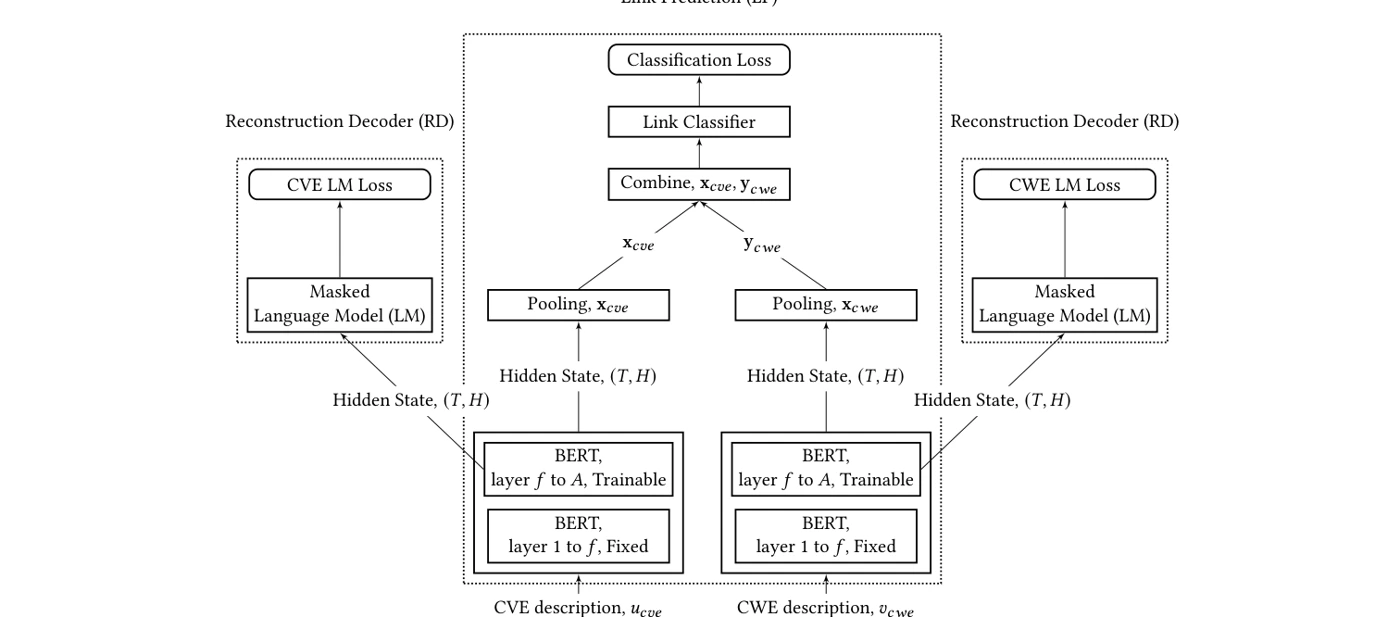
V2W-BERT: A Framework for Effective Hierarchical Multiclass Classification of Software Vulnerabilities
IEEE International Conference on Data Science and Advanced Analytics (DSAA), pp. 1–12 · 2021
A BERT-based framework maps vulnerability descriptions to a hierarchy of software weaknesses. Link prediction and a reconstruction objective support classification even when labeled examples for particular weaknesses are scarce.
BibTeX citation
@inproceedings{das_v2w_bert_2021,
  title = {V2W-BERT: A Framework for Effective Hierarchical Multiclass Classification of Software Vulnerabilities},
  author = {Siddhartha Shankar Das and Edoardo Serra and Mahantesh Halappanavar and Alex Pothen and Ehab Al-Shaer},
  year = {2021},
  booktitle = {IEEE International Conference on Data Science and Advanced Analytics (DSAA), pp. 1–12},
  doi = {10.1109/DSAA53316.2021.9564227},
  eprint = {2102.11498},
  archivePrefix = {arXiv},
  url = {https://doi.org/10.1109/DSAA53316.2021.9564227}
}
2019
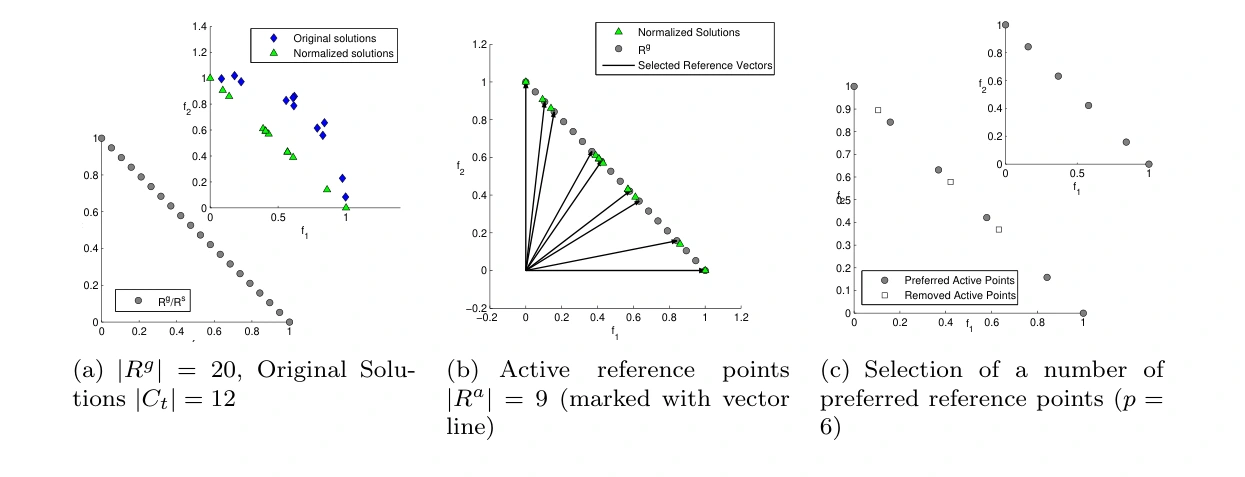
Evolutionary algorithm using adaptive fuzzy dominance and reference point for many-objective optimization
Swarm and Evolutionary Computation, 44, pp. 1092–1107 · 2019
An evolutionary optimization method combines adaptive fuzzy dominance and reference points to balance convergence and diversity when optimizing many competing objectives.
BibTeX citation
@article{das_fdea_2019,
  title = {Evolutionary algorithm using adaptive fuzzy dominance and reference point for many-objective optimization},
  author = {Siddhartha Shankar Das and Md Monirul Islam and Naheed Anjum Arafat},
  year = {2019},
  journal = {Swarm and Evolutionary Computation, 44, pp. 1092–1107},
  doi = {10.1016/j.swevo.2018.11.003},
  url = {https://doi.org/10.1016/j.swevo.2018.11.003}
}
2018
Exploiting a Synergy between Greedy Approach and NSGA for Scheduling in Computing Clusters
5th International Conference on Networking, Systems and Security (NSysS), pp. 1–8 · 2018
Cluster scheduling research combining greedy decisions with nondominated sorting genetic algorithms to handle competing performance objectives.
BibTeX citation
@inproceedings{das_greedy_nsga_2018,
  title = {Exploiting a Synergy between Greedy Approach and NSGA for Scheduling in Computing Clusters},
  author = {A. S. M. Rizvi and Tarik Reza Toha and Siddhartha Shankar Das and Sriram Chellappan and A. B. M. Alim Al Islam},
  year = {2018},
  booktitle = {5th International Conference on Networking, Systems and Security (NSysS), pp. 1–8},
  doi = {10.1109/NSysS.2018.8631376},
  url = {https://doi.org/10.1109/NSysS.2018.8631376}
}
2017
Many-objective performance enhancement in computing clusters
IEEE International Performance Computing and Communications Conference (IPCCC), pp. 1–2 · 2017
A many-objective view of cluster performance optimization, studying scheduling decisions across multiple competing system goals.
BibTeX citation
@inproceedings{das_cluster_2017,
  title = {Many-objective performance enhancement in computing clusters},
  author = {A. S. M. Rizvi and Tarik Reza Toha and Siddhartha Shankar Das and Sriram Chellappan and A. B. M. Alim Al Islam},
  year = {2017},
  booktitle = {IEEE International Performance Computing and Communications Conference (IPCCC), pp. 1–2},
  doi = {10.1109/PCCC.2017.8280491},
  url = {https://doi.org/10.1109/PCCC.2017.8280491}
}
No publications match this search. Try another topic or select “All work.”
Updated October 15, 2026. Figure excerpts are from the linked papers. Summaries describe the individual studies; paper links provide the full methods and results.